PVD · Particle transport
The same marginals. A different arrival pattern.
Reveal the angular dependence hidden by separate directional summaries.
Bottom first-contact fraction
Values & comparison details
Difference = comparison − reference. Rounded for display; original data retained.
- Diagonal distribution
- 53.333333333333336 %
- Anti-diagonal distribution
- 93.33333333333333 %
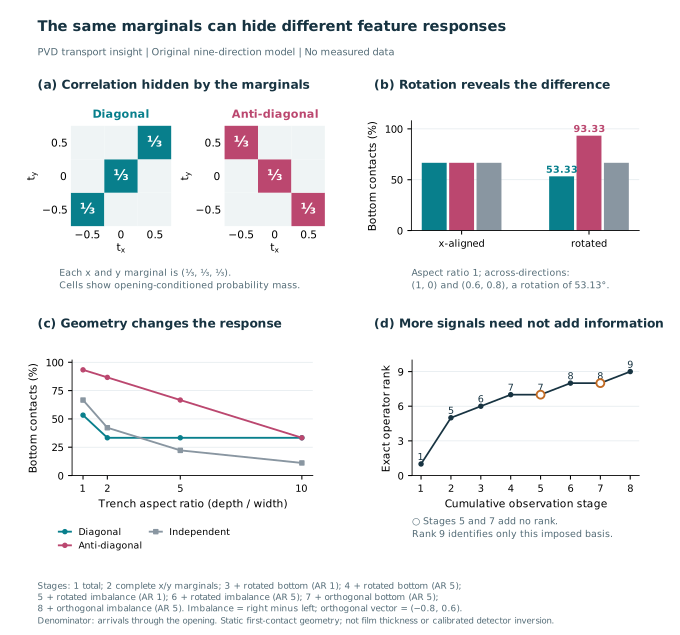
Same rotated feature. Fraction of the opening-conditioned incident population; not deposited thickness.
 Open full figure
 THE QUESTION
Can two angular distributions share both axis marginals yet deliver different first contacts to a rotated feature?
THE APPROACH
Three prescribed probability distributions on nine directions are passed through fixed first-contact geometry. Aligned and rotated feature responses are compared, then observation rows are added to an exact finite-basis rank analysis.
WHAT THE COMPARISON SHOWS
Three things to take away.
- 01
The diagonal and anti-diagonal distributions share the full axis marginals. In the aligned aspect-1 feature, both give a 66.67% bottom first-contact fraction.
- 02
Rotating that feature separates the two responses to 53.33% and 93.33%. The denominator is the opening-conditioned incident population.
- 03
The cumulative observation ranks are 1, 5, 6, 7, 7, 8, 8 and 9. Two added signals are redundant; more observations do not always add independent information.
Evidence, assumptions & the next question
What was numerically checked
Exact geometry and rank witnesses independently check the stored finite model. The sealed unit records 895 deterministic checks and 15 damaged-evidence refusals in each Python mode.
How far the result goes
A prescribed nine-direction model with fixed geometry. First contact is not deposited thickness. Finite-basis rank does not establish continuous angular uniqueness, measured chamber calibration or material-specific growth.
What a physical study would need next
Connect detector response, angular resolution and paired physical measurements before using this idea to infer a real process distribution.
SA-PROC-DEP-PVD-012 · Angular observability, unit 008 · 2026-10-02
The download contains selected plot data, captions and a redraw script. Source records and hashes keep the public figures traceable to the completed study.
RESEARCH SUPPORT · FIGURES · MANUSCRIPTS
Bring your question. Build the full story.
We can help organize your literature and numerical results, build scientific diagrams and figure sets, develop original cover concepts, and refine the manuscript around them.