HAR etch · Identifiability
The same marginals can tell different stories.
Show what separate angle and energy distributions leave unidentified.
Admissible interval width
Values & comparison details
Difference = comparison − reference. Rounded for display; original data retained.
- Marginals only
- 15 eV
- With one joint observation
- 6.25 eV
Energy per incident member. Width of admissible bounds, not a confidence interval or etch-rate improvement.
 Open full figure
 THE QUESTION
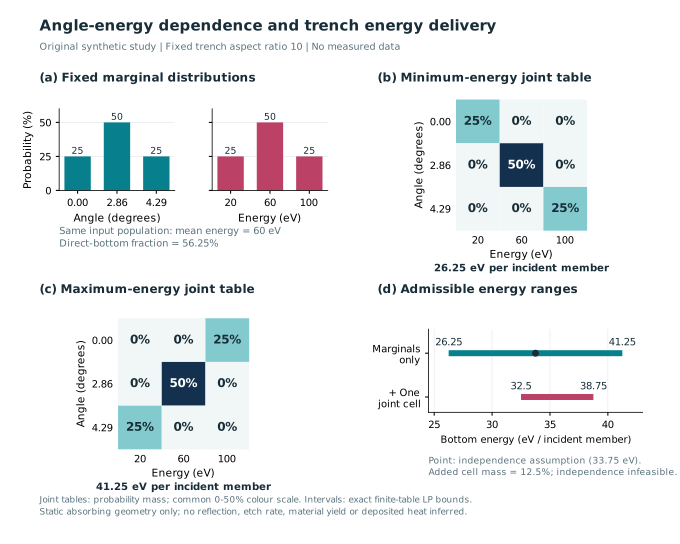
How much bottom-delivered energy can be inferred from separate angle and energy distributions?
THE APPROACH
A static absorbing trench with depth-to-width ratio 10 uses three angle categories and three energy categories. Exact finite-table bounds compare all admissible joint distributions, first with marginals alone and then with one hypothetical joint-cell observation.
WHAT THE COMPARISON SHOWS
Three things to take away.
- 01
Both extreme joint tables preserve the same 56.25% direct-bottom count fraction and 60 eV mean incident energy. Their delivered energies still differ.
- 02
One hypothetical joint-cell observation narrows the admissible interval to 32.5–38.75 eV per incident population member.
- 03
The independence assumption gives 33.75 eV, but its joint table violates the added observation. A scalar value inside the interval does not make the underlying model admissible.
Evidence, assumptions & the next question
What was numerically checked
Six stored optimization extrema across three finite cases agree with independent exact-rational vertex enumeration, an analytic control and primal/dual certificates.
How far the result goes
Synthetic prescribed probabilities and static first-contact geometry. These are admissible bounds, not confidence intervals. Delivered projectile energy is not etch rate, deposited heat, flux or material yield.
What a physical study would need next
Acquire joint angle-energy information and qualify reflection, charging, chemistry and evolving geometry before making material-specific etch predictions.
SA-PROC-ETCH-HAR-011 · Angle-energy joint identification · 2026-09-27
The download contains selected plot data, captions and a redraw script. Source records and hashes keep the public figures traceable to the completed study.
RESEARCH SUPPORT · FIGURES · MANUSCRIPTS
Bring your question. Build the full story.
We can help organize your literature and numerical results, build scientific diagrams and figure sets, develop original cover concepts, and refine the manuscript around them.